Three papers, one claim, one command each. The author thinks he is right and would rather be shown wrong than believed.
This page is the review. There is no venue, no referee and no gate behind the Efficient Thinking series; there is a public record, a reproduction that fails loud, and this invitation. It is written by an engineer from outside the research community, working with AI assistance, and it says so on the front page.
| Paper | What it claims | Read |
|---|---|---|
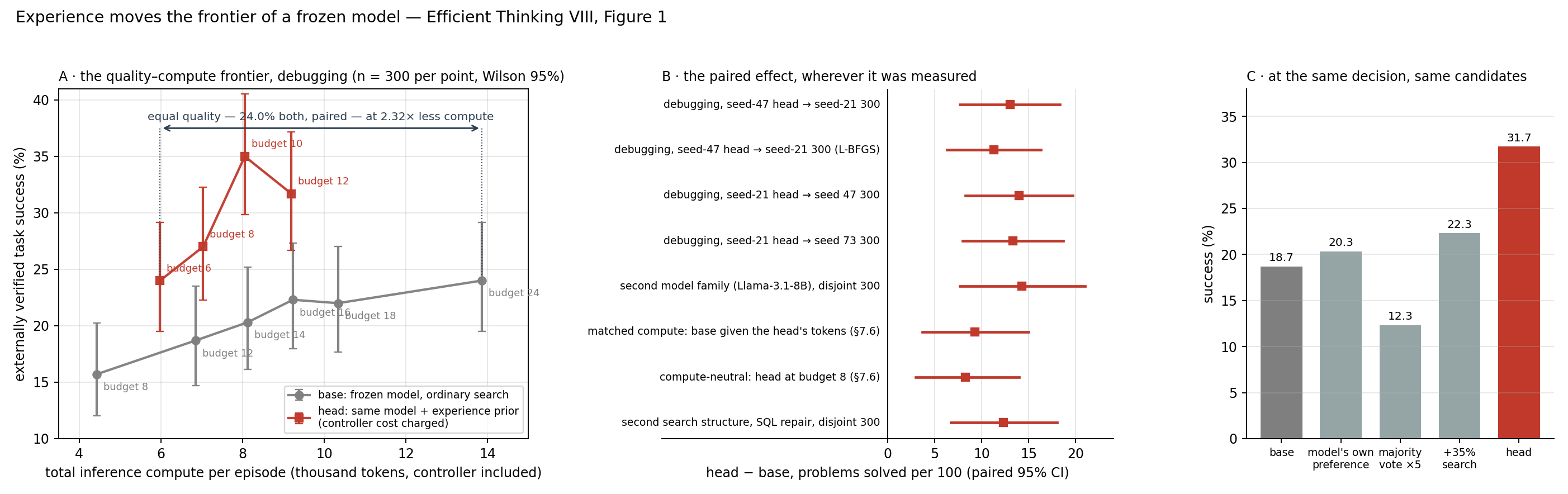
| VIII | A read-only linear head over a frozen model's own hidden state, fitted on its verified history, moves the quality–compute frontier: equal success at 2.3× less compute, +11 to +14 problems in 100 across four paired measurements of 300, and the model's own preference or a five-sample vote at the same decision do not reach it. | paper |
| VIII-b | Feeding the agent more of its own experience does not compound: the second generation's gain does not separate from the loop's run-to-run noise, because 49 to 86 percent of the new experience is byte-identical to the old — the policy returns to the same region. | paper |
| VIII-c | That plateau was acquisition, not exhaustion: the same head form on states gathered where a second agent stood, or where the agent was made to look first, restores gains of VIII's size (35.4% and 41.2% against 26.8% from the agent's own experience and 22.0% alone) on 300 unseen problems. The second agent was the experiment, not the mechanism. | paper |
Figure 1 of VIII, rebuilt from the repository's own result files by scripts/fig1_frontier.py.
A first pass over about twenty-five abstracts, not a survey; the papers' §6a carries the reasoning. The closest objects to this series' instrument are OLIVIA (a frozen LLM's action choice as a linear bandit over its hidden state, learned online outside the model), HSRM (a small verifier-trained encoder over a frozen generator's hidden states) and Multi-Head Latent Control (control heads over frozen latent traces for a quality–cost trade-off); the closest to "selecting experience for a frozen agent" is ExpGraph (an external experience graph with utility-ranked retrieval); ReBalance shares the deep-state steering instrument for reasoning economy. The closest to the plateau is the echo-gap result on memory-based self-improvement; the closest to the lever are the scout paper (trained) and DORA (training-free); the baseline class is ExpeL. None of them separates using experience from acquiring it with the model and the mechanism held fixed. If you know work that does, that is the most valuable finding this page can receive: file it.
An Apple-silicon Mac with about 16 GB of free memory, Python 3.9 or later with mlx-lm (tested at 0.29.1 on mlx 0.29.3), and the repository. The model is Qwen/Qwen2.5-7B-Instruct in bf16, pulled on first use, about 15 GB. Nothing leaves your machine.
git clone https://github.com/LouayAlsakka/efficient-thinking && cd efficient-thinking
Each script prints what it expects beside what it got, refuses to print a table if any of its gates fails, and exits non-zero if the published result is not reproduced. Read the header of each before running it; the cost is stated there rather than discovered at hour nine.
| Paper | Command | Wall clock |
|---|---|---|
| VIII | bash experience/reproduce_matched_compute.sh — the base given the head's compute against the head, n = 300, paired. An independent run on a second machine by someone who had not touched the work read +8.0 [+3.0, +13.3] against the published +9.3 [+3.7, +15.0]. | hours; see header |
| VIII-b | bash experience/reproduce_8b_accumulation.sh — the second generation's rise and the third generation's stop, both checked; a reproduction that confirms only the rise has reproduced half a claim. | hours; see header |
| VIII-c, our bytes | python experience/g13b_score.py --dir experience/results/viiic --plan viiic7 --out /tmp/viiic.json — rescores all seven arms and 33 pairings from the 189 published episode files, named by hash in experience/results/viiic_LOCK_v3.json. Needs Python 3.9+ with numpy (pip install numpy); no model, no GPU. | seconds |
| VIII-c, your bytes | bash experience/reproduce_8c.sh — regenerates both task sets from their seeds and proves them disjoint by program signature, collects the base and forced-look arms, fits the head, plays three games on 300 unseen problems, and prints your green counts beside ours against the session's own 3.67-point bar. A fresh head will not hash-match ours; the claim is the counts. | ~9 h, measured |
experience/results/viiic_repro/2026-09-27_stage6_output.txt; the self-experience arm is skipped by the script because its head is a VIII-b artefact this repository does not publish. Wall clock about 4 h 20 min on an M-series Ultra.The places the author thinks the results are weakest, stated by him so you do not have to guess. A finding that lands on one of these is expected; one that lands elsewhere is more valuable.
The claim on this page has been tested one way; a theory survives by being tested from more directions than its author thought of. The experiments below are the ones the author intends to run next, registered in the series plan with each reading written before the run. Readers are asked for the ones the author has not thought of.
Propose one. If there is an experiment on these systems that would test the theory harder than the five above, say so as an issue: what to vary, what to hold fixed, and what result would count against the claim. The author selects from the proposals, registers the chosen ones with their readings written first, runs them on the pool of M3 Ultra Mac Studios that produced every result on this site, and publishes each result on this page either way, with the proposer credited as above. The machines are the author's and are not offered for outside use; what is offered is the run, and the record of it.
From the author's side: one reproduction (the VIII-c from-scratch run on a second machine, above, all arms within the bar), and since then five further measured arms on the plan — VIII-d, VIII-e, VIII-f, VIII-g, and VIII-h awaiting its second read — each registered before its run, each locked and hashed before scoring. None filed from outside yet. The series' own withdrawals are on the papers' pages and in the register, dated: a contaminated arm read 134 of 300 and was withdrawn; a bar computed without the arm under test moved a verdict from 2 of 3 to 1 of 3; a proxy ranked three heads backwards and was retired as a diagnostic. They are left visible because a challenge whose author hides his own failures is not one.
Author: the address on the front page · github.com/LouayAlsakka/efficient-thinking · Efficient Thinking