Efficient Thinking
Can a fixed AI model become more capable without becoming larger?
Efficient Thinking measures how search, evaluation, feedback, experience, symmetry and representation change the useful capability obtained from a fixed model and a fixed compute budget.
→
III – V
Evaluation & feedback
→
VI – VII
Labels & the internal ceiling
→
→
→
Where this sits. The efficient-reasoning literature asks the same question and answers it from the compute side, by making a model think in fewer tokens. This series answers it from the experience side, with the weights frozen: what can a fixed intelligence be given to read, and how much does that buy. Two methods on one axis.
One question, from every angle: how much useful capability can a fixed intelligence get per unit of computation, and what moves that number? Each paper holds the model fixed, measures capability with an external verifier, and changes one thing: search, the evaluator, the judge, taste, feedback, labels, the internal ceiling, experience, symmetry, representation.
What each paper established, one sentence each:
- I — search extracts what the evaluator already contains.
- II — sampling saturates because errors correlate; only an external verifier lifts the ceiling.
- III — how much judging you get per unit of compute is itself the capability.
- VII — made to answer, the model says what its state knows; nothing is free inside.
- VIII — verified history, read by a frozen head, moves the frontier.
- VIII-b — a second generation of experience buys a small, consistent gain that does not separate from the loop's own noise; duplication revealed the saturation, and disjoint problems showed it was not the cause: the limit is the region of state space the policy keeps returning to (draft).
- VIII-c — a frozen agent's experience plateau can arise from how it acquires experience, not from exhaustion of its ability to use it: the same head on states from where a second agent stood, or from a forced first look, restores gains the agent's own experience could not. v1.0.12 · md
How the series reaches VIII
Paper VIII is the finding, and it stands on four results that came before it; each supplies a premise VIII needs, and none of them is a stepping stone only.
- I — capability can come from allocation, not size. A 14 MB chess net gains about 650 Elo from search alone, with the evaluator fixed: where computation is spent is itself a source of capability. VIII asks what can make that allocation better.
- II — search saturates, and only an external verifier breaks the ceiling. Sampling a fixed model converges to a consensus of its own errors; an external verifier is the one thing that lifts it. VIII's experience is labelled by exactly such a verifier, which is why it is "verified history" and not the model's opinion of its past.
- III — judging costs compute, and judging per unit of compute is itself the capability. A verifier is not free; an LLM judge beats majority vote only for weak policies and small fields. VIII's compute accounting carries the verifier's cost because III showed it must.
- VII — made to answer, the model says what its state knows; nothing is free inside. Under a forced-choice definition the elicitation claim failed at every size, which is the result: what the model can report is bounded by its state, and the state can be read directly. VIII reads it.
VI (the label ceiling: self-play stops where its labels stop being true; measured, unwritten) is VIII-b's relative on the training side. IV, V, IX and X are registered designs and ideas and say so.
The finding so far — Paper VIII and its chain
The claim, in one sentence. When intelligence is held fixed, the value of experience depends strongly on how that experience was acquired, not merely on how much experience is stored or how it is retrieved. Each clause is a measured result: how it was acquired (VIII-c: the same head on states from a forced first look, 41.2%, against the agent's own experience, 26.8%, and base, 22.0%); how much is stored (VIII-b: a second generation of the agent's own experience buys a gain that does not separate from the loop's noise); how it is retrieved (VIII-d: no selection rule beats a random draw from the same pool; VIII-e: prompt retrieval of it is a null, while the read-only head gains 13 to 15 points). Scope, stated so it cannot be taken away: the acquisition result is measured on one model family and one task family; what replicates across three families is the head's use of experience, not yet the acquisition effect.
What the series claims. This series separates the intelligence of a frozen model from the experience it can use and the experience it can acquire, shows each is measurable on its own, and finds that a learning plateau can belong to acquisition alone. The intelligence is held fixed by construction in every paper; experience is carried in a read-only channel outside the prompt; capability is verified externally and charged per unit of computation. The separation is demonstrated in one experimental system (VIII, VIII-b, VIII-c); whether it holds elsewhere is the question the reproduction route below exists to answer.
In plain words. A model that is never retrained can get better at a task by keeping a verified record of what it did before and reading it at each decision. Learning from its own past runs out quickly; learning from where another agent stood, or from a forced first look, goes further and restores the gain. The series measures each of these separately, on one system, and publishes the commands to reproduce them.
The method, in one sentence. This series treats the model's parameters as its thinking and never changes them; everything else that can move search — what the model is given to read, where that experience is collected, how it is applied at a decision — is varied one at a time and measured. Holding the thinking fixed is what lets each gain be attributed to experience rather than to a changed model, and it is what makes acquisition and use separable, measurable variables. The frozen-model-plus-readout half has neighbours (linear probes, contextual bandits over frozen states, hidden-state reward models; Paper VIII §6a). The separation of acquisition from use under a frozen intelligence, and the finding that acquisition is where the value moves, are this series' own.
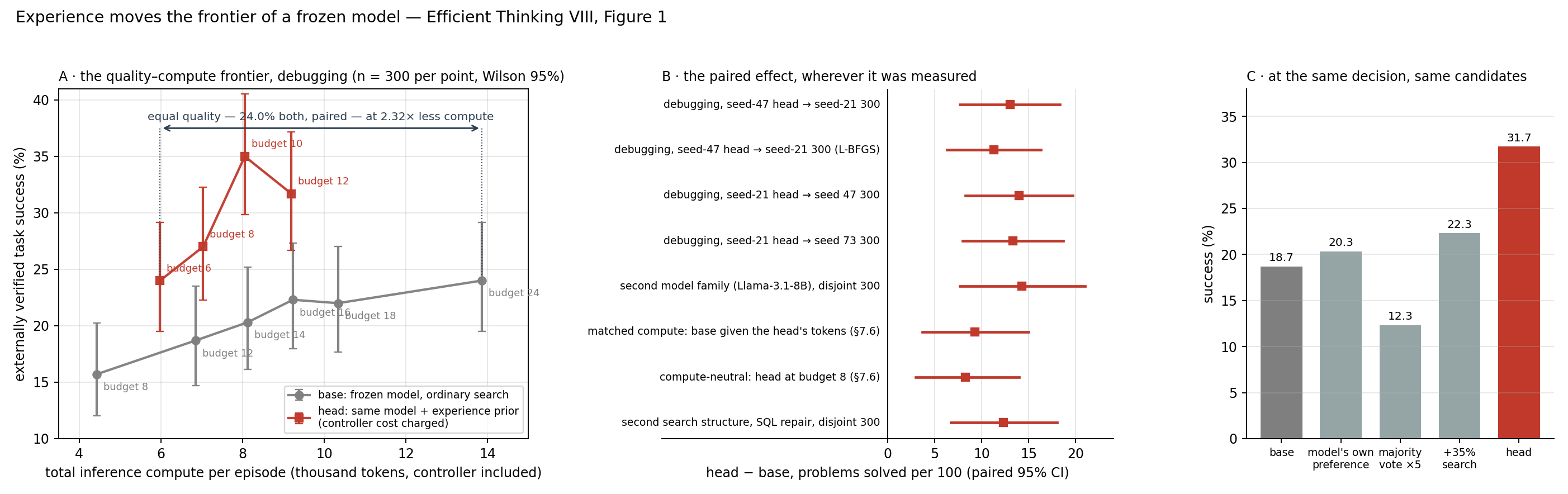
Where in the chain this works. The head does not choose a final answer from information already computed; it decides where the next inspection goes, which is where the next unit of computation goes, and that changes what the system subsequently sees. In that sense it is a learned search prior, closer in kind to the selection rule of a tree search than to a learned action classifier, and its measured effect is on allocation: equal quality at 2.32× less compute (Paper VIII §7.6). The closest published readouts learn which action to take in the state the agent has encountered; this series learns how verified past experience should redirect future search, and VIII-c moves one step further up: the policy used to acquire that experience determines how useful the resulting search prior is. The chain the series measures is therefore acquisition policy → experience → search policy → computation → outcome, with the intelligence fixed at every link. Paper I showed that better-allocated search can substitute for model size; VIII asks whether accumulated, verified experience can make that allocation better without touching the model, and VIII-c asks what experience to collect so that it does.
What the method risks, and how that is measured. Changing a model's parameters to improve it carries a cost that is hard to quantify: every regression suite the model passed was passed by the old parameters, and what the new ones lose is not known until it is found. This series never changes a parameter, so that cost is zero by construction, and every suite the vanilla model passes it still passes (Paper VIII, registered prediction P5, holds by construction). The method has a risk of its own, and it is stated here because a reader should ask: the head chooses among candidates the model itself proposed, so it can steer search away from a place where the vanilla model would have succeeded. That loss is measurable, problem by problem, on the same problems: how many the base solves that the head does not. Paper VIII §7.6 reports it at the equal-quality point — 24.0% both, paired on 300 problems, 33 discordant each way — so at that budget the head's losses equal its wins and the gain is all in compute. Measured across the closed arms (2026-10-05, derived from the episode files, every published mean reproduced): the regression cell runs from 1.2% of problems (family 1 at 4-bit, 11 of 900) to 12.2% (one label on family 1 at bf16, 110 of 900), and it does not track the headline gain — the largest gains carry the smallest regressions. Against the stricter denominator, the problems the vanilla model itself solved, those same cells are 11.7% and 59.8%; both denominators are published, and the second is the one that prices the behaviour. Every arm publishes that four-cell table (both solve · head only · base only · neither) beside its headline, so the regression is a number on the page, never an inference. A head is fitted on one task family's verified history and, in every measured result, applied only within that family — the second search structure in Paper VIII got its own head, not a carried one — so the regression is bounded to the family where it is measured, and outside it the vanilla model runs unchanged. What a head does when applied outside its family has not been measured; it is registered as the next control, so that the per-family rule rests on a number rather than on caution.
The finding — Paper VIII-c
VIII is the setup; VIII-c is the finding. Same frozen model, same read-only head, 300 unseen problems. The base solves 22.0%. A head fitted on the agent's own experience reaches 26.8%, a gain that does not separate from base against the loop's own noise, and a second round of its own experience adds nothing separable (VIII-b). The same head fitted on experience recorded from where a second agent stood reaches 35.4%; fitted on experience from a forced first look before guessing, 41.2%. Nothing about the model or the head changed between those columns — only where the experience came from. That is the claim: a frozen agent's learning plateau can belong to acquisition alone. The head itself is not new: a small readout over a frozen model's hidden states, fitted on verified outcomes, is the same object as a value head or a learned verifier, and this series says so. What is new is what is held fixed and what is varied: the model and the head stay the same while only the source of the experience changes, which prompt-based memory cannot isolate, and which was not found in the value-function work read for the related-work pass.
Reproduce it. The published bytes rescore in minutes; the whole run regenerates from scratch in about four and a half hours on an Apple-silicon Mac, and did so on a second machine within the pre-registered bar (base 0.22 and forced-look 0.89 points from the published means, against a 3.67-point bar).
git clone https://github.com/LouayAlsakka/efficient-thinking && cd efficient-thinking
python experience/g13b_score.py --dir experience/results/viiic --plan viiic7 --out /tmp/viiic.json   # our bytes, minutes (needs numpy)
bash experience/reproduce_8c.sh                                                                      # your bytes, ~4.5 h
Paper: VIII-c · pdf · the whole chain on one page, with measured numbers only: the discovery chain · the series as slides: one slide per paper · how to attack it: the challenge page.
The setup — Paper VIII
VIII — Experience, in three papers.
- VIII · Utilization — verified experience improves a frozen model.
- VIII-b · Saturation — more experience gathered by the same policy stops producing separable gains.
- VIII-c · Acquisition — the plateau can arise from where experience is acquired; changing the acquisition policy restores useful gains.
Together, VIII to VIII-c separate three things usually called learning: fixed intelligence, the ability to use experience, and the ability to acquire experience worth using. Paper I began by asking how to spend an inference budget; VIII-c ends by asking how to spend an experience-acquisition budget.
Papers I–VII establish the frontier and its limits: search moves a fixed model along its quality–compute frontier, and only external information raises the ceiling. Paper VIII is the first paper in the series to move the frontier itself; VIII-c is what the series claims.
The setup, and the result to try to break in it. A frozen 7B model, given a read-only linear head fitted on its own verified history, solves more problems at the same inference compute — and, at equal quality, spends 2.3× less. The mechanism transfers to a second search structure with the head re-fitted. Whether a second generation of experience beats the first is being measured against the loop's own run-to-run noise, replicate against replicate, and is not claimed here.
The headline reproduces from one command in about three hours on an Apple-silicon Mac.
| Model | Qwen2.5-7B-Instruct, bf16, weights never changed; the head is a linear layer read from one hidden layer (18) at one decision |
|---|
| Task | Debugging: 300 synthetic programs with an injected bug; the agent inspects, hypothesises a region, patches and runs the tests. Every task has a sibling region so the symptom cannot give the bug away |
|---|
| Capability | Problems solved, decided by the test suite, never by a model. Paired per problem; 95% intervals from a paired bootstrap; McNemar on the discordant pairs |
|---|
| Compute | Total tokens per episode with the controller's own inference charged; the matched control gives the base the head's token budget |
|---|
| "Verified history" | The frozen model's own earlier episodes on other problems, labelled by the test suite — not by the model, not by a person. Only successes teach; the head is fitted once and never updated during the run |
|---|
| Second family | Llama-3.1-8B, weights never changed, its own head fitted from its own history: +20.0 points on the held-out slice, +14.3 [+7.7, +21.0] on a disjoint 300 (Paper VIII §7.4) |
|---|
| Third family | Yi-1.5-9B-Chat (4-bit), registered before any compute, scored 2026-10-03 after an independent second read: the head beats base by +21.3, +22.0, +23.0 and beats prompt retrieval by +20.7, +22.0, +22.3 in three games, both criteria each time; retrieval against base is a null. The verdict transfers across families, the size does not (plan, VIII-f) |
|---|
| Second structure | SQL query repair against a fixed schema; regions are clauses; the verifier is the result set. The head was re-fitted there from that environment's own history, so the mechanism transfers, not the weights |
|---|
git clone https://github.com/LouayAlsakka/efficient-thinking && cd efficient-thinking
bash experience/reproduce_matched_compute.sh      # base at the head's compute vs the head, n = 300, paired
It refuses to print a table if any gate fails and exits non-zero if the published interval is not reproduced. An independent run on a second machine by someone who had not touched the work read +8.0 [+3.0, +13.3] against the published +9.3 [+3.7, +15.0].
The series — measured papers
Updated 2026-10-04. VIII-d to VIII-h are measured arms written as entries on the series plan; their short papers follow. Every entry carries its registration, its lock and its reading as fixed before the run.
| # | Title | State | Read |
|---|
| I | Measuring What Capability Costs — a 14 MB chess net gains ~650 Elo from search alone | closed; archived 2026-07-24 (DOI) | html · pdf · md · doi |
| II | Where Search Pays and Where It Can't — sampling saturates at a consensus ceiling that only a verifier breaks | closed; archived 2026-07-24 (DOI) | html · pdf · md · doi |
| III | Efficient Judging — an LLM judge beats free majority vote only for weak policies and small fields | closed; archived 2026-07-24 (DOI); P3 left unscored, recorded | html · pdf · md · doi |
| VI | The Label Ceiling — self-play stops where its labels stop being true | measured, unwritten | concept · ledger |
| VII | The Elicitation Gap — how much a model knows that it does not say | draft v0.5, E-E complete at four sizes: under the pre-registered forced-choice definition the claim FAILS at every size — the forced judge rises 0.53→0.73 while the probe at matched depth stays flat and the tie rate collapses 99%→21%; the abstention was format and scale fixed the format; the registered residual failed scoring | html · md · concept |
| VIII | Experience Priors — a frozen model learns where to look from its own verified past | closed, reproduced | html · pdf · md · doi |
| VIII-b | Does Experience Accumulate? — a second generation buys a small consistent gain that does not separate from the loop's noise; duplication revealed the saturation and disjoint problems showed it was not the cause — the limit is the region of state space the policy returns to | draft v0.3 — every registered arm run | html · md · record |
| VIII-c | Where the Experience Is Acquired — the plateau of VIII-b was acquisition: a head of identical form on states from another agent's places (35.4%) or from a forced first look (41.2%) beats the agent's own-experience head (26.8%) and base (22.0%) on 300 unseen problems; the second agent was the experiment, not the mechanism; its groups contribute (half the forced groups plus them recover most of the gain); the cheap proxy tracks amount, not origin | closed v1.0.12, reproduced on a second machine 2026-09-27 | html · pdf · md · doi · challenge |
| VIII-d | Selecting Experience — among three rules for choosing which 132 past states to fit the head on (coverage, readability, a mix-matched control), no rule differs from another by more than the design's ~5-point resolution, and none beats a random draw from the same pool: the +3 to +8 that looked like selection was the pool | measured 2026-10-01/02, five arms, registered before each draw; written as plan entries, short paper pending | result |
| VIII-e | Retrieval Against the Head — prompt retrieval of past experience (k=1, matched bank) adds nothing and costs 5.9% more input; the frozen head beats it by 13–15 points in every game; between the verifier label and the agent's-own-pick label both help and the difference is below the ~6.7-point resolution | measured 2026-10-01, fifteen games; the 23-point offline advantage of one label converted to no in-loop advantage (seventh non-conversion in the programme) | result |
| VIII-f | A Third Family — Yi-1.5-9B-Chat at 4-bit under the same protocol: the head beats base +21.3/+22.0/+23.0 and beats retrieval +20.7/+22.0/+22.3, three of three; retrieval against base is a null. The verdict transfers across families; the size does not | measured 2026-10-03, registered before compute, independent second read | result |
| VIII-g | Steering From the Verifier's Label — the precondition the adaptive-steering authors named (a separable success signal in hidden space) is not met for this label at layers 18 and 27: d′ 0.74/0.77 against a bar of 2, and less separable than the agent's own pick; the candidate ends at its first gate | measured negative 2026-10-03, 0.85 h; does not conflict with VIII-f (within-task d′ excludes the structure a cross-task head uses) | result |
| VIII-i | The Quantisation Control — family 1 at the same 4-bit as the third family: the head beats base +26.9 and retrieval +28.8, both criteria, three of three; retrieval against base is a null for the third time. "Survives 4-bit" is now a measurement on both families | measured 2026-10-05, registered before compute, second read signed | result |
| VIII-h | Which Label Makes the Better Head — on nine disjoint task sets with a pooled estimator, the verifier-label head beats the agent's-own-pick head by +16.6 points, interval [+14.6, +18.5], nine of nine; useful experience carries information the agent did not already hold in its own behaviour | measured 2026-10-05, criterion ruled symmetric before any count was read, second read signed | registration |
Registered designs and ideas
Designs and concepts with no measured result yet. Each carries its own state line; none is a finding.
| # | Title | State | Read |
|---|
| IV | Search Where Taste Is the Evaluator — poetry and music, where no checker can score the answer | machine arms measured; rater arms running | proposal |
| V | The Exchange Rate of Feedback — improvement per bit of human correction | concept | concept |
| IX | Symmetry — solve one case, cover its whole orbit; test a prior for reading surface | concept | concept |
| X | Machine-Native Representation — is language the efficient form for a machine to reason in | concept | concept · plan |
Read the table by its state column: the measured and written papers say so, the drafts say draft, and the rest are registered designs or ideas, and say so. The series is one investigation, and most of it is still ahead.
To cite. Papers I–III are archived as one record: Alsakka, L. (2026). Efficient Thinking series 1-3. Zenodo. https://doi.org/10.5281/zenodo.21520992. Papers VIII and VIII-c are archived together: Alsakka, L. (2026). Efficient Thinking VIII and VIII-c: Experience Priors; Where the Experience Is Acquired. Zenodo. https://doi.org/10.5281/zenodo.23005271. Papers not yet archived are cited by this site's URL and the paper's version line.
Every paper opens with a state line — MEASURED, REGISTERED, CONCEPT or IDEA — so that a concept is never read as a finding. Withdrawn claims stay in the record, dated. Readings are written before runs. Result artefacts name their instruments by hash. The series plan and the one-question rule are in series-completion-plan.md.
Review
The challenge page: the claim, one command per result, the four places the author thinks each paper is weakest, and the terms of review.
There is no venue, no referee and no gate. Review is public and runs through the repository's issues. The four places the author thinks Paper VIII-c is weakest, so you know where to aim: the acquisition rule on a second task family (if "look before you commit" during collection does not move a head there, the claim is one family's); the exchange rate between forced-look and second-agent experience, measured in either direction; a held-out proxy that recovers the game ordering across the four heads, which would falsify the claim that the proxy tracks amount and not origin; and the noise floor, if the within-arm bar is shown too permissive or session drift larger than the base's within-day stability. Paper VIII's four are on the challenge page. A fatal flaw is worth more than praise, and the author will run any experiment you name.
Author
 Louay Alsakka. An electrical engineer from the semiconductor industry who has worked at companies large and small; this is a first research project, done outside any institution with AI assistance, and published directly. The chess engine of Paper I is where the two interests meet.
Private review: louayalsakka [at] gmail [dot] com.
Repository: github.com/LouayAlsakka/efficient-thinking
Site build after e567b61 · 2026-10-07 13:27Z. Every version is a commit; a fixed copy of this page is at github.com/LouayAlsakka/efficient-thinking, and a reviewer can cite the build shown here.